The Braver journal
Toward a world without faxes
A few weeks ago, several articles about the fax appeared in the media, and many of our friends and collaborators shared them with us, encouraging us to comment publicly. We did not, partly because we were short on time, but above all because this is a complex problem that we at Braver do not believe can be approached lightly.
 Marie-Lou Gagnon

We think about that famous fax every week, but not as an obsession with replacing it. Simply imagining a new digital process that substitutes for the fax's analogue process will certainly not have a truly transformative impact on our healthcare system. To create the healthcare world of tomorrow, we must imagine something different, transformative, but also natural (and which will probably make the fax unnecessary). And above all, we need to take action.
That world of tomorrow — the one where faxes no longer exist — must be built with an understanding of how healthcare workers operate today, but also with enough imagination to invent new practices that may still be in their infancy today.
When writers discuss the fax, it is often from the perspective of exchanging data trapped on paper, for which interoperability between information systems seems a natural solution. Instead of writing data on a paper form and faxing it to another professional who will have to digitize it, why not enter the data into a computer system that can send it securely and directly to the system used by the recipient? We save time and paper, and avoid privacy risks! Yay!
However, we are creating a process that is a digital copy of the fax.
What if we brought people into the equation?
The fax, born in the 1960s, allows documents to be sent from one institution to another, from one provider to another, to inform them or exchange a particular patient's clinical data.
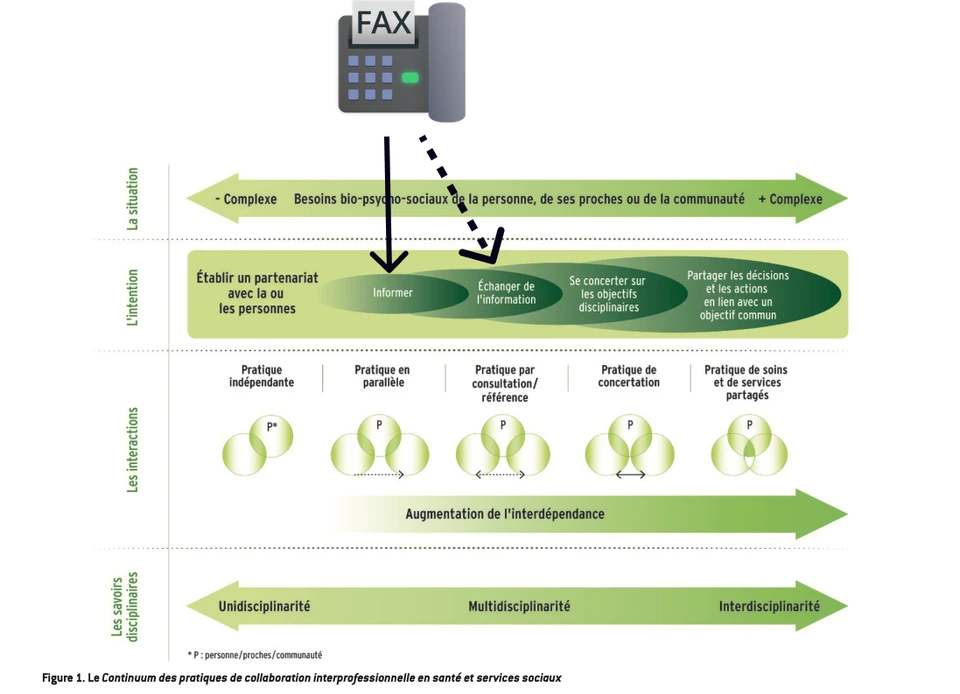
English transcript of the original French diagram
Figure 1. The continuum of interprofessional collaborative practices in health and social services.
- Situation: the biopsychosocial needs of the person, their loved ones or the community progress from less complex to more complex.
- Intentions, from left to right: establish a partnership with the person or people; inform; exchange information; coordinate around disciplinary objectives; share decisions and actions linked to a common objective.
- Interactions, from left to right: independent practice; parallel practice; consultation/referral practice; coordinated practice; shared care and services practice. The circles become more interconnected and overlapping as the practices move to the right.
- Direction of change: increasing interdependence.
- Disciplinary knowledge, from left to right: unidisciplinarity, multidisciplinarity, interdisciplinarity.
- Legend: P = person / loved ones / community.
- Fax overlay: the fax icon points toward the “Inform” and “Exchange information” portions of the continuum.
As the figure above (reference), produced by Université Laval's Réseau de collaboration sur les pratiques interprofessionnelles en santé et services sociaux, shows, informing another party is the prelude to interprofessional collaboration. In other words, the fax allows the healthcare network to support basic collaboration in which healthcare professionals tend to practise in parallel.
This dynamic of interaction between healthcare professionals is extremely important to consider, since it is an integral part of the network's reality. And these interactions are not about to stop. Whether we think of population ageing, home care, workforce shortages or expanding scopes of practice, a major trend has been taking shape over the past 15 years: care teams will need not only to collaborate effectively, but also to do so while working at a distance from one another.
The importance of collaboration in healthcare has been recognized for more than 30 years. In fact, in 1988, the World Health Organization (WHO) published two major reports on the subject: “Learning Together to Work Together for Health” and “Multiprofessional Education of Health Personnel in the European Region.” However, it is mainly over the past decade that the need to collaborate has become a priority for many decision-makers. For them, effective interprofessional collaboration is not only a way to increase productivity and the quality of care and services provided, but also a critical component of improving human resource management.
Approaching fax use solely from the perspective of transmitting information therefore seems to me a major mistake; we stand by this position, and we were already discussing it in 2020 in our blog post Behind every fax and email is a human being. And the facts bear this out, since healthcare professionals find themselves having to annotate their faxes and PDFs or, worse, write paper letters if they want to exchange more information. This leads me to believe that interoperability between information systems is not enough to eliminate the fax.
The person providing care needs more
I have repeated this on several occasions in my blog posts: the transmission infrastructure that is the fax inhibits the potential for collaboration in healthcare and affects the quality of care. To me, it is unacceptable for a pharmacist to hold back a pharmaceutical opinion that could benefit a patient because the communication channels are unsuitable.
Interoperability is certainly a fundamental piece of the puzzle. However, by focusing so much on the path of structured data, we end up forgetting the grey matter that is also circulating: information exchanged between clinicians, rather than between systems.
To truly engage in consultation, coordination or shared practice, a clinician must be able to go beyond simply transmitting data. They must be able to draw on the secret weapon human beings have possessed for thousands of years: dialogue. Not dialogue mediated by faxes or emails, but truly frictionless dialogue.
So some will say the fax does the job. But can we hope for better for the thousands of healthcare professionals who make up our healthcare system?