The Braver journal
Behind every fax and email is a human being (3/3)
When we began writing this series of articles, we were not yet in isolation. We had decided to break down human communication and deepen our understanding of its role in healthcare. We wanted to put all the thoughts jumbled up in our heads down on paper and share them with you.
 Marie-Lou Gagnon
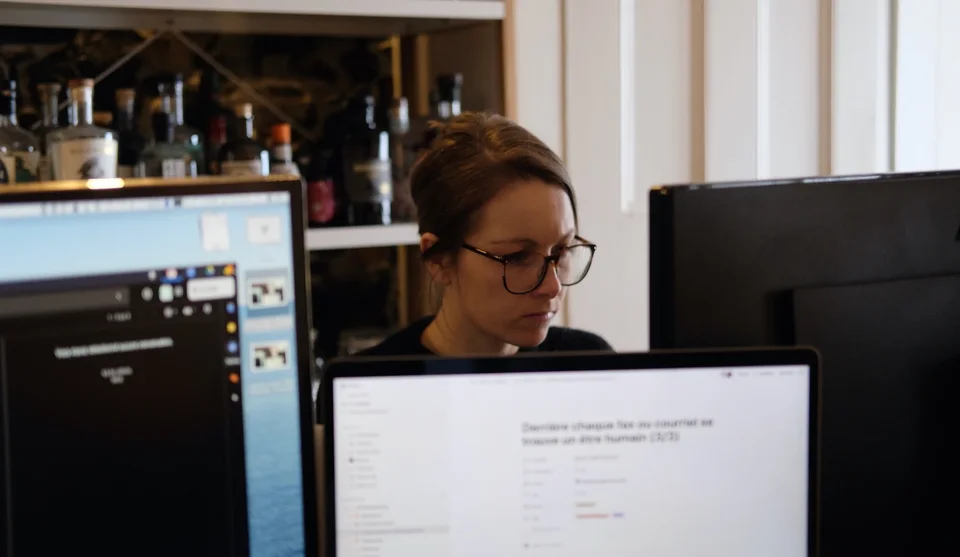
Since entrepreneurship is often about timing, you could say it was unusual timing to publish part 1 of this series on Thursday, March 12. First, because our first two articles got somewhat lost in the flood of COVID-19 content on social media. But above all, because addressing human communication during this crisis led us to take our thinking further. Fully absorbed in our new way of life, where we practise "social distancing," find new ways to meet up with friends remotely and see the community more connected than ever, this series of articles has taken on an unexpected meaning.
Our system under pressure
The coronavirus situation reflects, admittedly in an exacerbated way, several characteristics of our healthcare system: the intensity of our healthcare professionals' work, our system's limited capacity, the importance of recognizing the expertise of certain professions, and legal frameworks that are sometimes restrictive. But the crisis also shines a light on the power of a community that collaborates and helps one another. And without this collaboration, our healthcare system would inevitably be weaker.
To be able to manage extreme situations, the people within the system therefore need to be able to collaborate effectively. They need to be able to work effectively as a team. And one of the pillars of successful teamwork is successful communication.
In part 1 of this series, we identified that the faster the communication cycle:
- The more effective communication could be
- The more misinterpretations could be avoided
- The less demanding communication was for the people involved
For example, one type of tool that incorporates these characteristics very well is instant messaging.
In part 2, we identified that the more nonverbal information communication included, the more it was possible to:
- Express empathy and establish trust
- Improve teamwork and its effectiveness
Tools that are too "functional"?
We have talked about it several times, and we keep driving it home: in healthcare, efficiency is essential. Yet the tools currently available to healthcare professionals are very limited and do not always meet this need for efficiency.
Of course, there are tools that "do the job" and can be described as functional, such as the fax. It is very functional because it fulfils a very specific purpose: being a communication channel that allows documents to be sent. Period.
This function is essential in the healthcare system and meets a minimal need for collaboration within the collaboration spectrum, as we saw in this article.
It does not allow us to develop a relationship of trust with the person sending it. The reality is that a fax we receive in our office amounts to a piece of paper conveying data useful to our work. And that piece of paper does little to make us realize there is a human being at the other end who has taken the time to share this information with us and cares about the patient's health just as much as we do.
A changing care environment
But beyond that, the healthcare system must contend with evolving healthcare. Healthcare professionals' expertise is becoming increasingly specialized, and people increasingly want care that fits their condition and their values. This means a patient moves between the public and private systems, consulting a psychologist, then a chiropractor, kinesiologist or acupuncturist. As a result, care teams are no longer always under the same roof, which inevitably compromises their collaboration around the patient when it is needed.
This practice environment makes interprofessional collaboration much more complex, because few solutions enable effective communication between providers working in different locations.
But is there a solution?
In our view, if we want to make teamwork and communication more effective throughout the healthcare system, we first need to go beyond simply making primarily functional modes of communication more efficient. For example, letting professionals send one another faxes on their cellphones will not truly improve the situation.
We need to break down the paradigm and take a fresh look at communication. And the premise Braver uses to break down and rebuild that paradigm is this: natural face-to-face communication is, in itself, highly effective.
Our challenge, then, is to transform this face-to-face human communication into a new, more practical mode of communication when the people involved are not in the same place. Or there at the same time. How? By taking all the theoretical elements we discussed in the first 2 parts and mixing them together, we get the perfect formula (in our opinion):
- A simple, intuitive application
- Secure instant messaging
- Transcribed voice or video recordings
- A network of verified, accessible professionals
In our view, these ingredients are essential to improving communication between professionals and therefore fostering collaboration around the patient. But above all, what underlies these ingredients is the establishment of trust between the people communicating, because ultimately, it is that trust that will make a team truly effective.
We too often forget that human beings are social beings, even in a professional setting. We too often forget that healthcare professionals are usually invested heart and soul in their patients' health and want the best possible care for them.
So why don't we build on this enormous potential instead of acting as though human beings love sending one another faxes or emails, reinvented or otherwise?