The Braver journal
Surviving lockdown with your partner: our reality over the past 20 months
Mathieu and I have now been working together for nearly 20 months. Whether at home or at the office, we spend our days collaborating and taking our business a little further every day. Over those months, people have often told us, "Wow! I could never work with my partner."
 Marie-Lou Gagnon
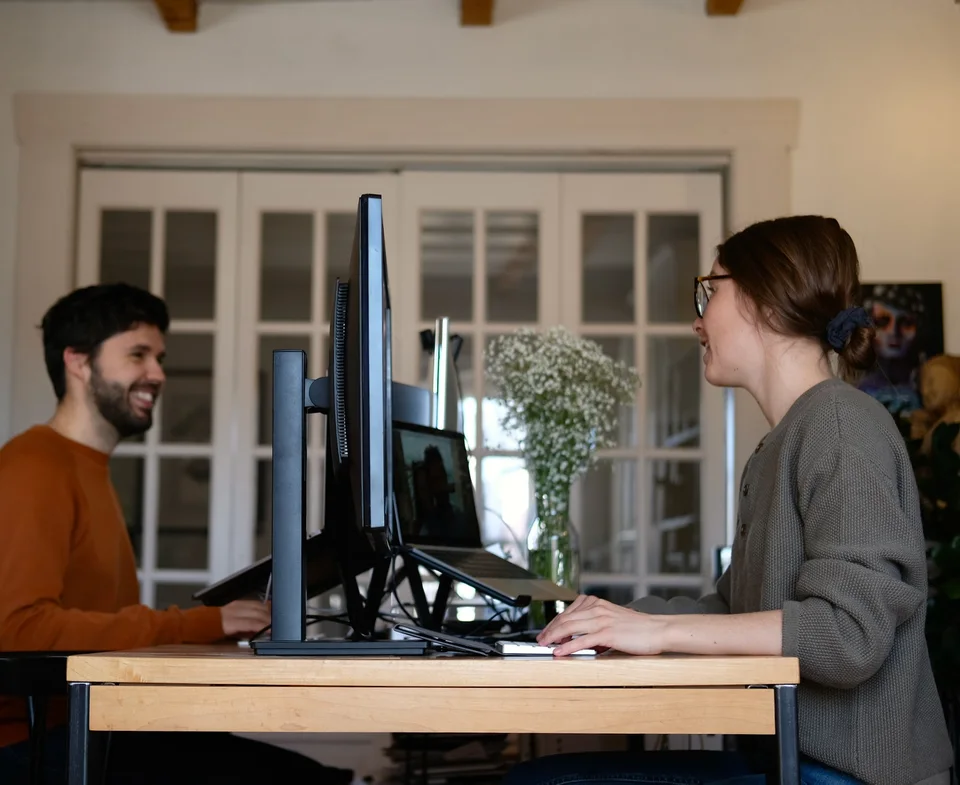
And with good reason! We can completely understand that this way of life is not for everyone. Right now, though, we are thinking of those same people who, through force of circumstance, find themselves spending their days working from home alongside their other half. Since this is a major challenge we too have been experiencing for quite some time, we thought we could share what we have learned over the past 20 months. And who knows, perhaps our experience will inspire a few people!
Disclaimer: we do not have children. Our living situation is therefore simpler than that of many couples.
Getting to know the other person in their working role
When you go into business with someone in your family, there is one side of their personality you may not always know: their relationship with work. Our working identity is a very important part of who we are, and although we share some of it with those around us, it is a "secret garden" that we tend to share with our colleagues.
Of course, I was aware of Mathieu's relationship with work, but observing that relationship is nothing like being involved in it.
Before I started working with him, it was as though I saw him working "from a distance". I was not emotionally involved in his work. And the same was true for him. We would come home after our respective days, set our big bags of worries on the dinner table, and listen to each other kindly while trying to find solutions to the other's problems. It was nice to help one another.
But since we have had a business together, one person's problems have also become the other's. I am no longer just the caring partner who wants to help her spouse; I am now also the business associate who is anything but emotionally detached from her business partner's challenges. (It must be a little like being a parent, I imagine?)
This new reality pushed us to develop a new side of our relationship. And I believe it is very important to look at this new relationship with fresh eyes, free of expectations and preconceived ideas. As though we were starting from zero and giving ourselves the chance to discover one another differently, with all the sensitivity that comes naturally when we begin a new relationship.
Starting from zero is not always easy, however, because the way we perceive our roles as workers and romantic partners seems to be naturally associated with spaces and times that are often different (source).
According to psychologist Dr Johan Autruc, "some people may find it difficult to play their role as a worker and their role as a romantic partner at the same time. The transition to working from home destabilizes this dynamic. Suddenly, home becomes a place where I will have to play a role that is usually different." (source) In other words, our points of reference have changed.
In our experience, successfully combining these two roles first took time: we had to be understanding with ourselves and with each other, and give ourselves time to get used to this new balance. We also had to show openness, listening, communication, empathy and respect. It takes teamwork, but also work on yourself.
Mathieu and I could never have made it through the past few months without creating this climate of communication and empathy; it made it much easier to respect each other's needs. And those needs are often unfamiliar at the beginning of the journey that leads us to share this part of our lives with our partner.
Each person and each couple will reach their own conclusions about their working roles, but in our case, we had to acknowledge that our relationships with work were different. That sometimes creates situations in which my needs are the exact opposite of Mathieu's. And it is precisely in those moments that we need to put into practice what we have learned over all these months. And remind ourselves again and again of how crucial communication is. Throughout these months, we have constantly had to:
- Understand our own needs and communicate them
- Understand what we expect from the other person and share it with them
- Listen to the other person's needs and expectations without feeling threatened
- Make sure our vision is evolving in the same direction
- Find compromises in a climate of trust and mutual support
- Support each other through the hardest moments, even when our needs are incompatible
For some, all of this may seem intuitive, but sharing our daily working lives with our family is very different from what we are used to. The close bonds we share with our loved ones can sometimes make us more vulnerable. And that vulnerability can even lead us to activate certain mechanisms more quickly, exposing our worst behaviours.
For example, it is much easier to express our irritation without a filter to a partner who interrupts us 3 times in an hour than to a colleague. Or it may be easier to feel "attacked" by our partner's words when they express dissatisfaction after their workday. In short, opportunities for conflict arise a little more easily.
But although the current situation brings its share of challenges, sharing daily life with your partner 24 hours a day can also lead to a wealth of beautiful moments. For our part, we often remind ourselves how lucky we are to get to know all these sides of each other and to realize that we still have so much to discover.
In fact, one day, an 80-year-old patient who had been married for 50 years told me with conviction that a partner is not a possession; they are a whole human being, with all their complexity. And that complexity is not always easy to understand. I often tell myself that I will need an entire lifetime to get to know myself well. And imagine, I have been “spending” 24 hours a day with myself for 32 years. So it will be almost impossible for me to get to know every one of Mathieu's many little facets, even with an entire lifetime ahead of us.
What I am really trying to say is that these moments together, even when they bring challenges, are above all a wonderful opportunity.
An opportunity to create even more memories; to seize that spontaneous conversation at the corner of the table while lingering over one last sip of coffee.
An opportunity to get to know the other person in ways that may have escaped us before; to watch their concentrated expression as they tackle a difficult task, and their satisfied smile when the problem is solved.
An opportunity to have time, just a little more time; to exchange a tender glance over the computer, because there will never be enough of those glances.