The Braver journal
How can we be stronger than the status quo?
When I think about the idea of change, my first instinct is to ask what it means to me. How do I, Marie-Lou, handle change in my life? And the simple answer is: sometimes well, sometimes less well.
 Marie-Lou Gagnon

In other words, my ability to handle change does not always correlate linearly with the scale of that change. I wonder how, at certain times in my life, I have managed to confidently embrace major life changes, while at other times, a small change has unsettled me out of all proportion. Yet when I look back on those times when I successfully handled a change or a new situation, what I remember is feeling confident, equipped and supported.
But why was I able to feel that way in the face of certain changes? What were the right conditions, the ideal context that allowed me to face change courageously?
I ask myself this because I want Braver to succeed in creating those feelings in our clients. We are obviously not change management specialists, but as the disruptive element that brings about change for our clients, I am certain we have a vital role to play.
Understanding our biases
Many irrational factors guide an individual's choices every day. Behavioural economics is a field of science that seeks to describe and explain why, in certain situations, human beings behave in ways that may seem paradoxical or irrational.
One significant bias that can emerge when change occurs is status quo bias.
Status quo bias is an emotional bias; a preference for the maintenance of one's current or previous state of affairs, or a preference to not undertake any action to change this current or previous state. (link)
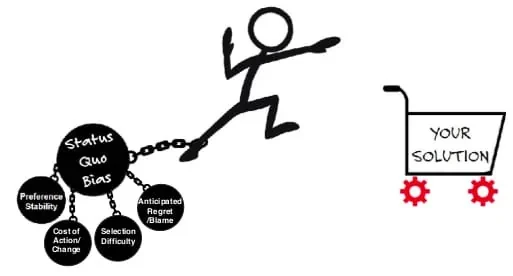
While reading about status quo bias, I came across this evocative image showing the 4 reasons why human beings do not want to change (link).
- Preference for stability
- Cost of change
- Difficulty choosing
- Anticipated regret and blame
Among my various explorations of the subject, Dan Ariely and a few articles, including this one, have inspired me greatly and provided the foundation for some valuable thinking in our go-to-market efforts.
Our role
Showing an unexpected path
Resistance: Preference for stability
Desired feeling: surprise
Humans generally have a strong preference for stability. This preference often becomes apparent when we are faced with something new. For example, when a new technology solution is presented to us, we instinctively look for similarities with what we already do.
As a result, we may tend to believe that the existing situation is already very similar to the proposed change, and that we therefore do not need to change.
To counter this preference for stability, the recommendation is to surprise people. How? By presenting needs they had not considered, and how aspects of the solution adequately address them.
Over Braver's history, I must have presented our platform thousands of times, and I still question how I present it. I still remember meetings where I was presenting Braver and people did not understand why clinicians needed to talk to one another or why text messages were not enough. In those moments, I have sometimes frozen, unable to understand why Braver's potential, so obvious to me, was not obvious to them. My vision of our potential impact was so clear that it worked against me.
I believe it is essential to show empathy and adopt a beginner's perspective, even after several years. The people in front of us are not specialists in the problem we are trying to solve, whereas we are. We therefore need to learn to present our solution from an angle they simply would not have considered. Let us help people see the world we have imagined more clearly.
Reflecting the cost of the status quo
Resistance: Cost of change
Desired feeling: confidence
The natural human tendency is to see the cost of change rather than the cost of the status quo. Probably because the cost of change is more concrete. To counter this natural tendency, we must not only present the benefits of change, but also make the cost of the status quo more explicit: naming and, if possible, even measuring the impact of keeping things as they are.
One challenge we have faced has been understanding this cost for the many stakeholders in the healthcare ecosystem. For example, clinicians have more personal concerns, while decision-makers/buyers are more often concerned about resource efficiency or quality of care.
For a clinician, the cost of continuing to use unsecured text messages for clinical communications might therefore be:
- Intrusion into their private life
- Risk of medical error
-
Increased mental load
- Fear of forgetting a communication
- Having to go back and delete a photo
Whereas for decision-makers/buyers, it might instead be:
- Non-compliance
- Risk of legal action
- Loss of fluidity
To reflect this cost of the status quo, it is essential to start listening right at the beginning of a meeting, so we can identify the profile of the person we are speaking with and the kinds of concerns they face. Then all that remains is to choose the right tools from our toolbox.
Making the before and after very concrete
Resistance: difficulty choosing
Desired feeling: feeling equipped
Figuring out how to reach a specific destination when you do not know exactly where you are starting from can quickly become complicated. Yet that is somewhat what we ask of people when we show them our solution's potential and everything they will be able to accomplish with it. Implicitly, we are asking them to board the train without really knowing the extent of the journey.
However, if we make an effort to reflect their current situation, then describe the situation they could find themselves in thanks to our solution, the path between those two points becomes much clearer. This is what we might call a gap analysis. In a way, that gap represents the effort they will need to make to reach their goal. What we have observed, however, is that this is often not enough. It is also important to make the path from A to B explicit. By making the before and after very clear, and also describing the path to take, they will feel better able to rise to the challenge.
All of this sounds good in theory, but you know what? As a startup, when we innovate, we do not always have a map of the route. Sometimes we discover the path step by step as we move forward. Personally, I have found this quite difficult at times. I would have liked to offer our first clients clearer answers and a more predictable process. I would have liked to be an expert rather than a learner.
But even in these situations, what matters is having the analytical ability and open mind that allow us to quickly identify pockets of value for the people in front of us and contrast them with the difficulties they encounter in the field.
So, however we get there, our role here is to help the person we are speaking with understand how they will move from before to after, and to feel equipped and supported along a path that is, all things considered, achievable (especially when compared with the cost of the status quo)!
Anticipated regret and blame
Resistance: anticipated regret and blame
Desired feeling: feeling supported and validated
When faced with a decision, most of us tend to anticipate its potential negative outcome, creating a fear of being held responsible. It is as if people are thinking to themselves: "Things may not be perfect right now, but at least I am not dead yet!" This perspective can, however, hamper our ability to make bold, innovative decisions.
One recommended method for reducing this anticipation is to draw on peers' experiences. It is important for those experiences to be shared fully and transparently, describing the initial challenges, the process of change and the subsequent results. This makes it easier for people to identify with the situation and feel part of a group moving forward together in the same direction, which can be extremely encouraging.
As a small business, finding our place and establishing credibility within our vast healthcare system takes hard work, consistency, rigour and a great deal of time. It is essential to be patient and seek to build trusting relationships with those valuable collaborators who will want to be the first heroes of this adventure, of this wheel that is beginning to turn. So what is our role in this story if we are not the hero? How do we help future clients feel that the hero does not yet exist, but could be them? In this situation, our role is to inspire, to instil the energy that gives people the courage to do things differently.
At Braver, we may not (yet!) be change management experts, but we are undoubtedly agents of change. For that reason, our role gives us an enormous privilege: to surprise our clients and help them feel confident, equipped and supported. Change is rarely comfortable, but what I have learned over the years is that it is inevitable if we truly want to make great strides forward. And to borrow Barack Obama's words, “Change is never easy, but always possible!”